Project Overview
This project is an ESP8266-based smart call bell system, inspired by hospital setups and built to provide care for a family member. It combines a physical alert system with IoT notifications, ensuring that a call for help is both heard locally and confirmed remotely. The system also doubles as a room environment monitor, tracking temperature and humidity.
The Motivation: A Real-World Need
This project was born from a pressing personal need. Following a surgery, my father was bed-ridden, and I required a reliable way for him to call for assistance from his room. Inspired by the call bell systems in hospitals, I designed this solution.
Given the urgency, the system was assembled very rapidly to be deployed at his bedside immediately. This project, my first in electronics, is a testament to rapid prototyping to solve an immediate, real-world problem.
How It Works
The system is split into two parts: a patient “remote” and the main controller unit.
- Patient’s Remote: A simple breadboard with a push button was connected via a long wire to the main unit and placed at my father’s bedside.
- Activation: When he pressed the button, the ESP8266 microcontroller registered the signal.
- Alert: The ESP8266 immediately triggered two actions:
- A loud buzzer, mounted in the central hall, would start beeping.
- A “Call” notification was sent via Arduino IoT Cloud to my smartphone.
- Acknowledgment: The only way to silence the buzzer was to physically go to the room and press a second “reset” button located on the main wall-mounted assembly.
- Confirmation: Pressing the reset button sent a second “Call Answered” notification to the cloud, confirming that someone had physically attended to the call.
This “no remote dismiss” feature was a specific design choice to ensure no call could be accidentally or remotely dismissed without someone physically checking in.
Core Components
- Microcontroller: ESP8266 (for processing and Wi-Fi connectivity)
- Sensor: DHT11 (for temperature and humidity monitoring)
- Display: 16×2 I2C LCD (to show room environment data)
- Input: Two push buttons (1x remote “call,” 1x local “reset”)
- Output: Piezo buzzer (for the audible alert)
- Platform: Arduino IoT Cloud (for notifications and data logging)
Project Status & Retrospective
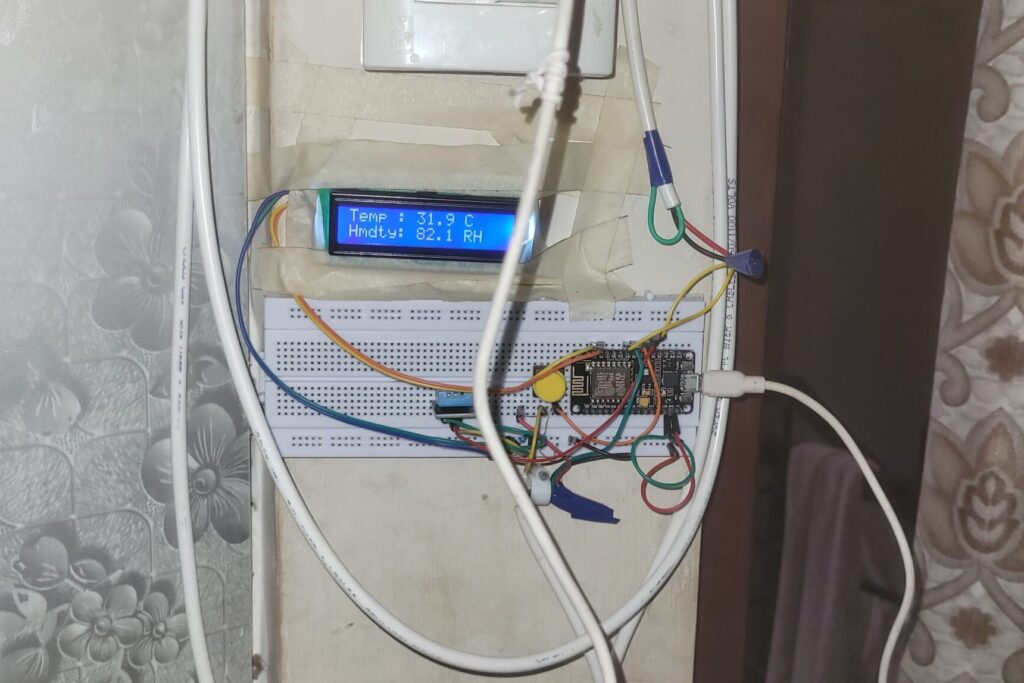
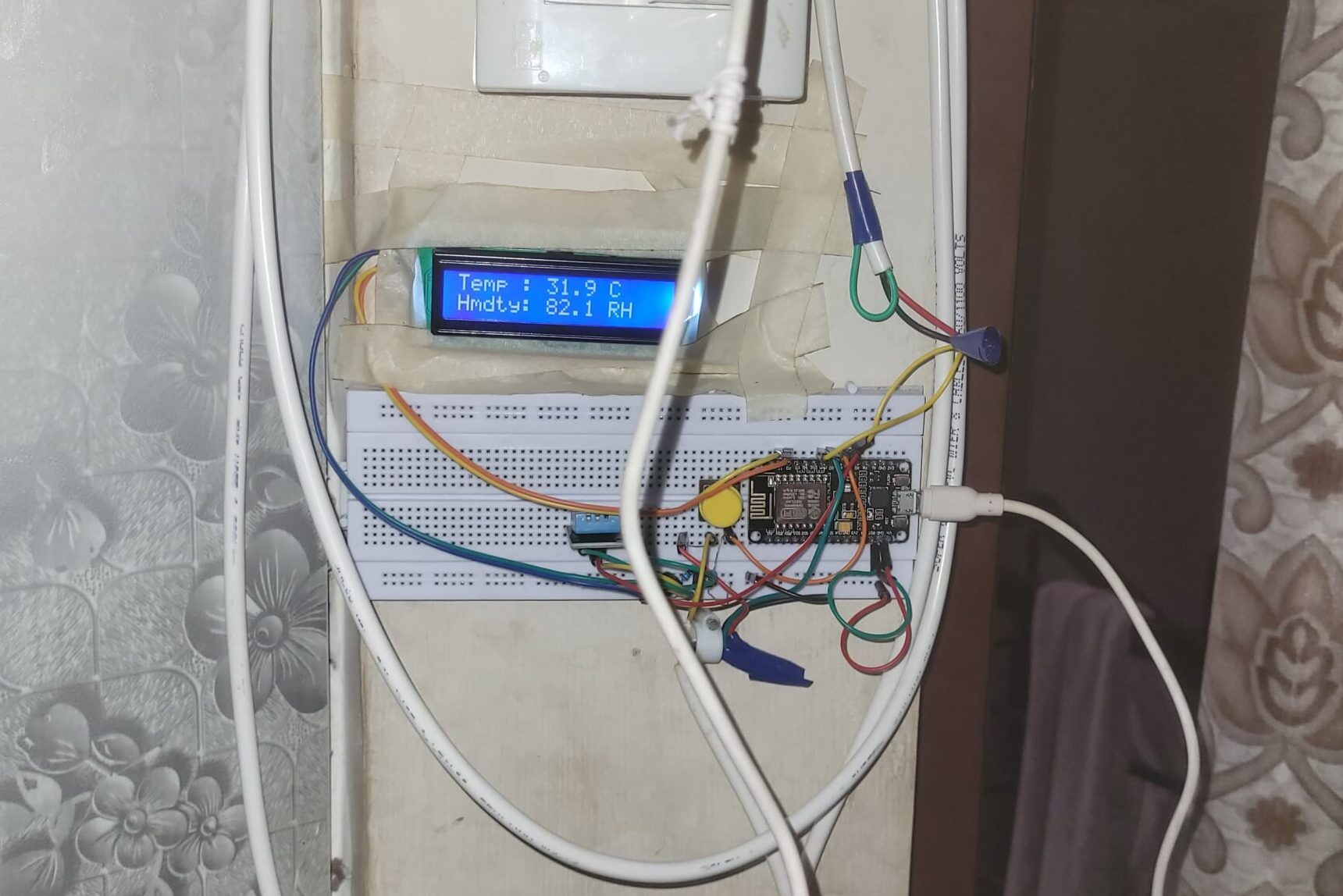
As this was a rapid prototype built under urgent conditions, its construction is function-over-form, as seen in the photo. The documentation is sparse, and the original code has unfortunately been lost.
Despite its rough assembly, the project was a complete success. It functioned reliably 24/7 during the entire recovery period, providing immense peace of mind for my family. It was a powerful first lesson in how electronics can be used to create practical solutions that have a direct, positive impact on people’s lives.
Image Gallery